
Most organizations don't have a BI tool problem. They have a BI governance problem.
Companies invest heavily in modern data stacks, yet a familiar pattern keeps appearing:
- Multiple dashboards showing different numbers for the same metric
- KPIs defined differently across teams
- Unclear ownership of data and logic
- Reports multiplying faster than trust in them
The issue is rarely the technology. The issue is the lack of a governed BI ecosystem.
What Is a Governed BI Ecosystem?
A well-designed BI environment is not just about visualization tools. It is a connected system:
And sitting across all of those layers is Governance.
Governance is not about restricting data. It is about enabling trusted, scalable analytics.
From Reporting to Governance: My Perspective
My first experience with BI didn't start as a BI role.
I was working as a process specialist, focused on operations and continuous improvement. I knew how to work with data — Power BI, Power Apps, and the Power Platform — so I started building dashboards.
At first, it worked.
- Manual Excel reporting was eliminated
- Processes became more efficient
- Teams had better visibility
But over time, new problems started to appear:
- Multiple dashboards showing the same KPIs
- Different reports showing different values for the same metric
- Constant requests for new KPIs with no clear ownership
- No clarity on which report to trust
- Everyone had access to everything
- Broken pipelines and outdated reports
- No monitoring or control over usage
- Declining trust and adoption
Even simple changes became complex. To update one KPI, I had to modify multiple reports in multiple places.
That was the moment I realized: the problem was not BI tools. The problem was the lack of governance.
So I stepped back and looked at the bigger picture. Instead of building more dashboards, I started asking:
- Who owns the metrics?
- Where should logic live?
- How do we ensure consistency?
- How do we scale this?
That's when I discovered: a governed BI ecosystem is not optional — it is foundational.
Since then, I've been focused on learning BI governance principles, applying best practices, and building systems — not just reports.
BI is not about creating dashboards. It's about creating trusted decision systems.
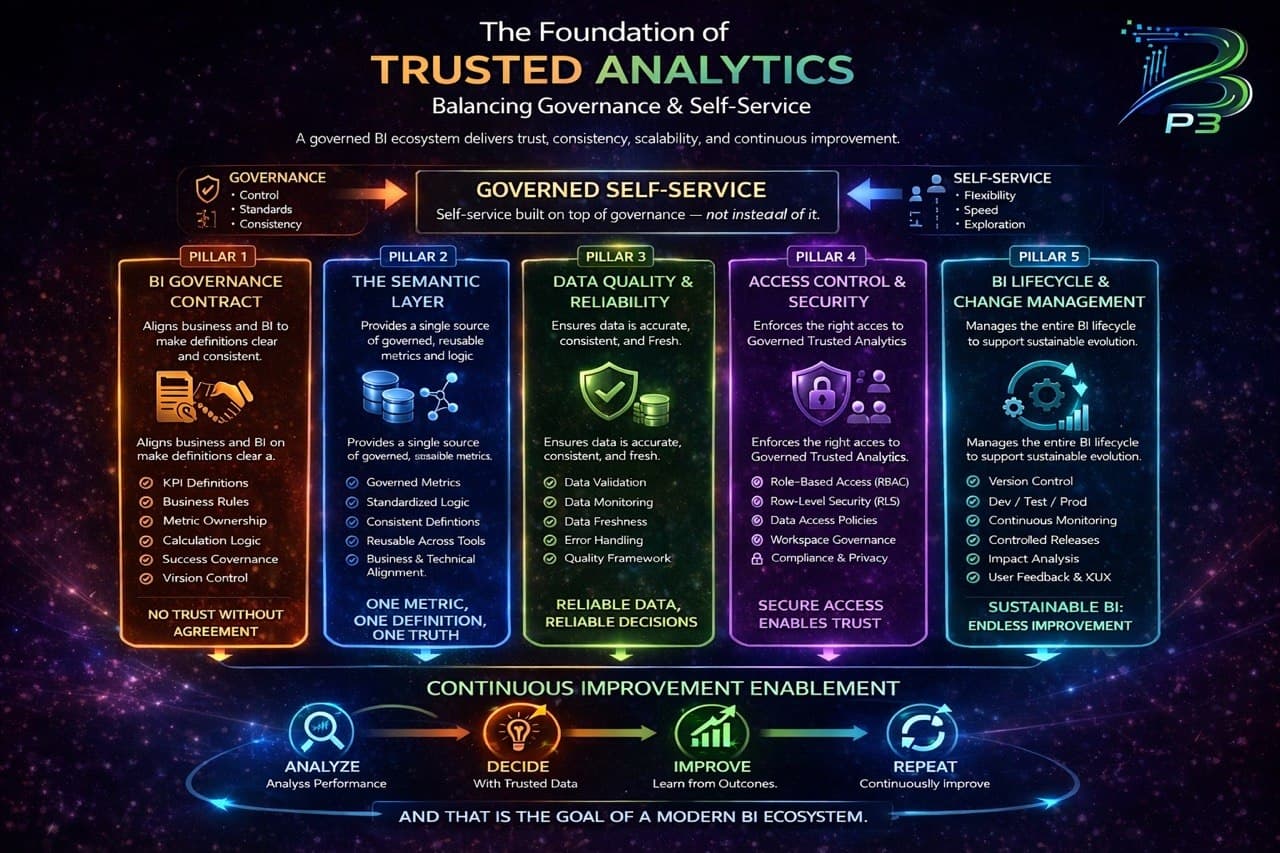
The 5 Pillars of a Governed BI Ecosystem
After working through the problems above, I identified five foundational pillars that make BI ecosystems trustworthy and scalable.
The Contract Between Business and BI
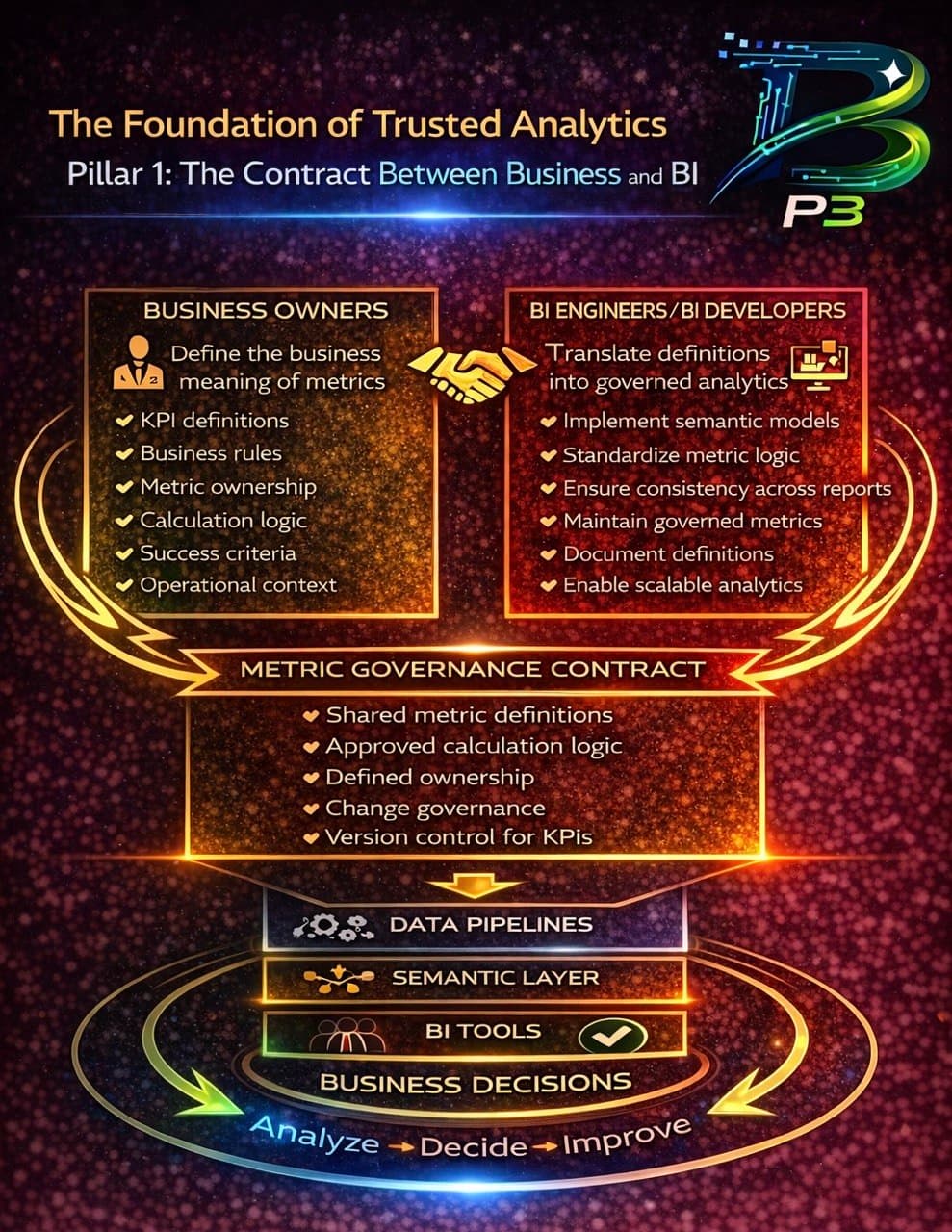
Pillar 1 — The governance contract between business and BI
Governance does not fail at the level of definition — it fails at the level of implementation.
A governed BI ecosystem requires a clear operational contract between three layers:
- Define KPI meaning
- Own business rules
- Translate definitions into governed models
- Standardize logic
- Build reliable pipelines
- Ensure freshness and reliability
The Semantic Layer — The Enforcement Layer
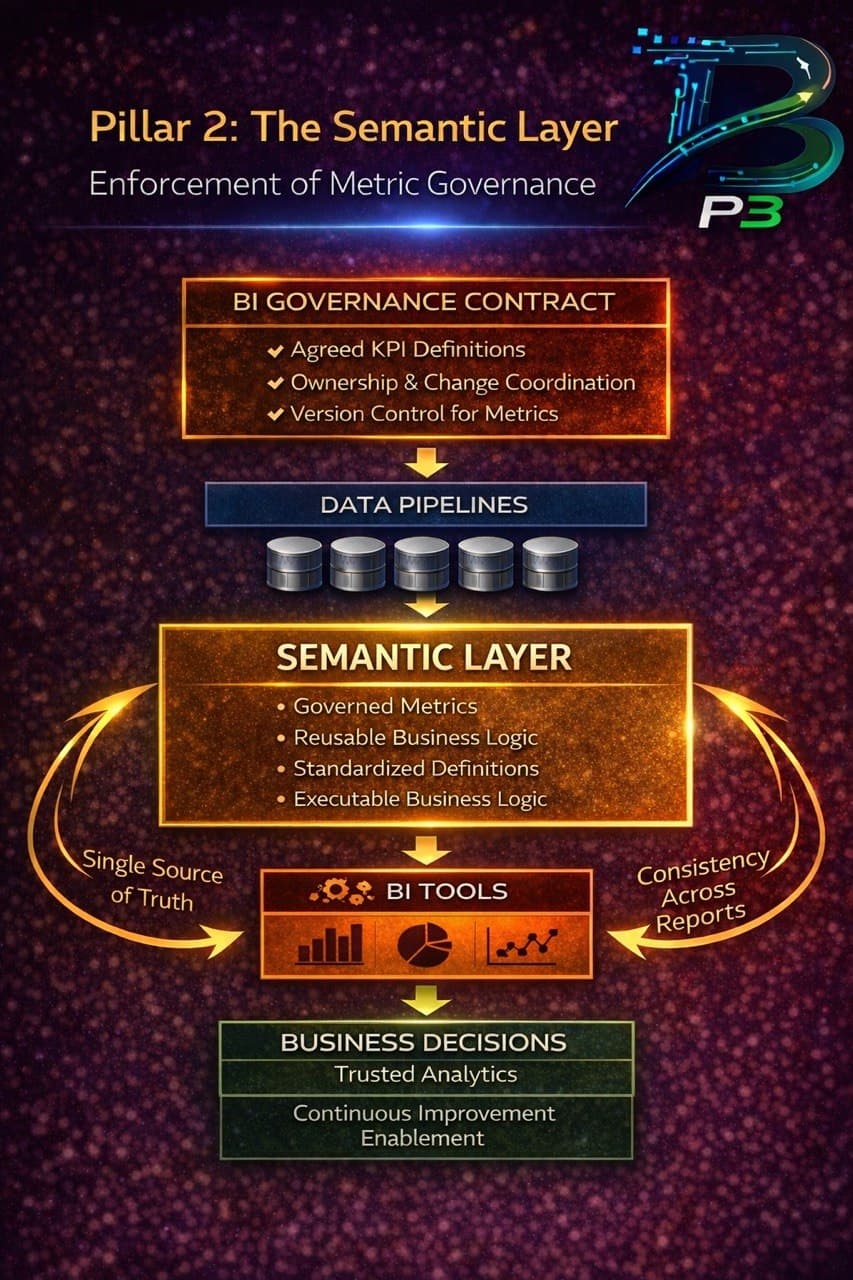
Pillar 2 — The semantic layer enforces the contract
The semantic layer enforces the contract. Without it, metrics drift, logic duplicates, and governance breaks. With it:
- Metrics are defined once
- Reused everywhere
- Automatically updated when definitions change
Data Quality & Reliability
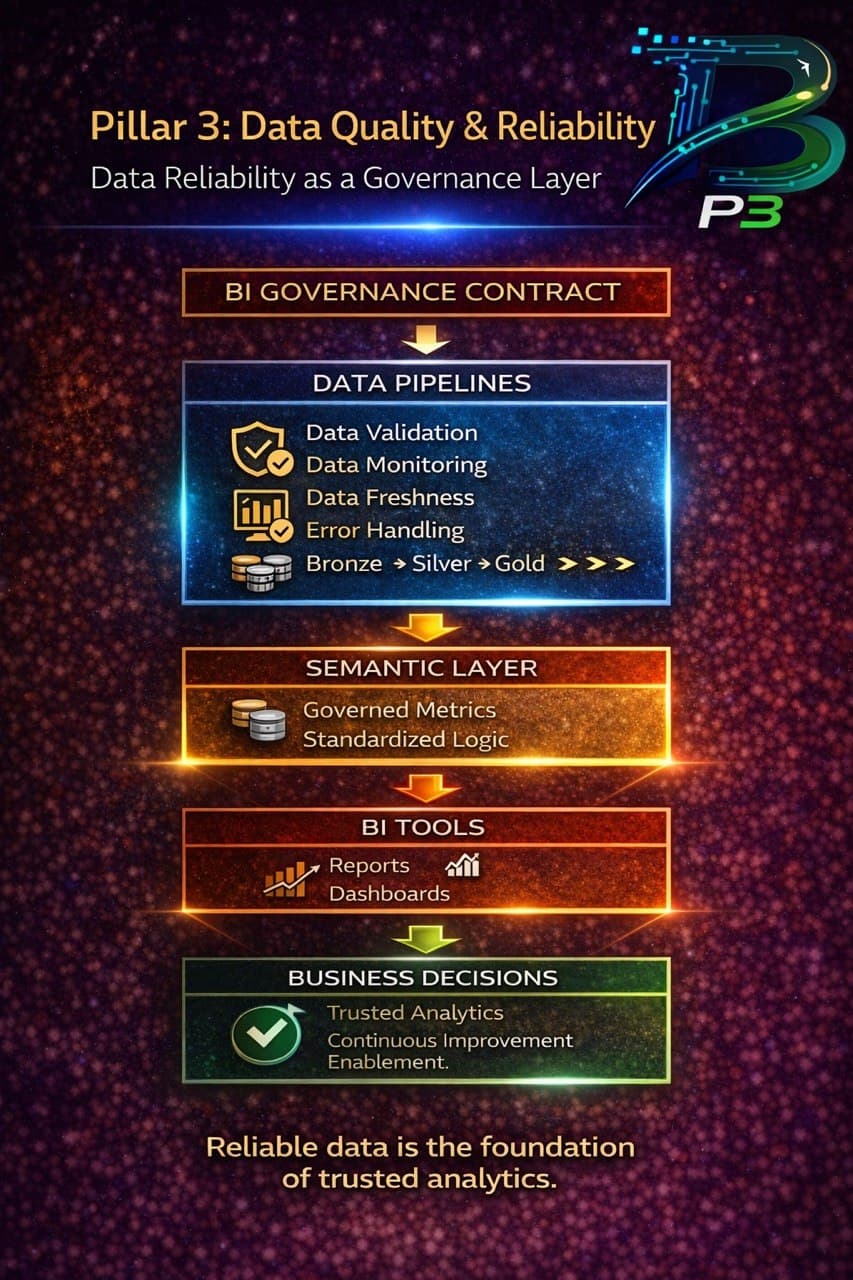
Pillar 3 — Data quality and pipeline reliability
Data quality breaks trust before dashboards do.
Common issues that erode trust: missing data, pipeline failures, and silent delays. Teams stop trusting data not because the BI layer broke — but because the data feeding it was never reliable.
Access Control & Security
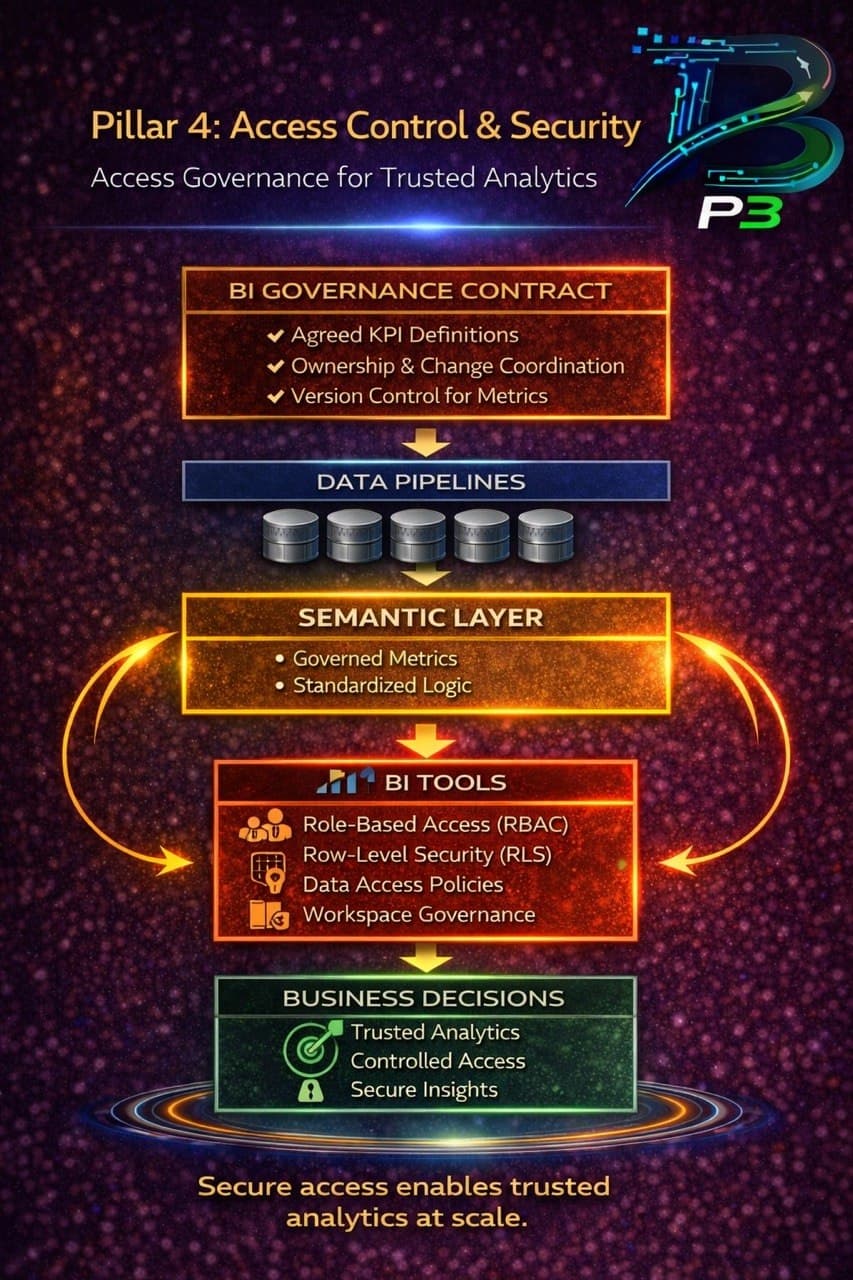
Pillar 4 — Access control and security
When everyone can see everything, trust degrades — not through malice, but through confusion. Governed access ensures users see what's relevant and accurate for their context.
BI Lifecycle & Change Management
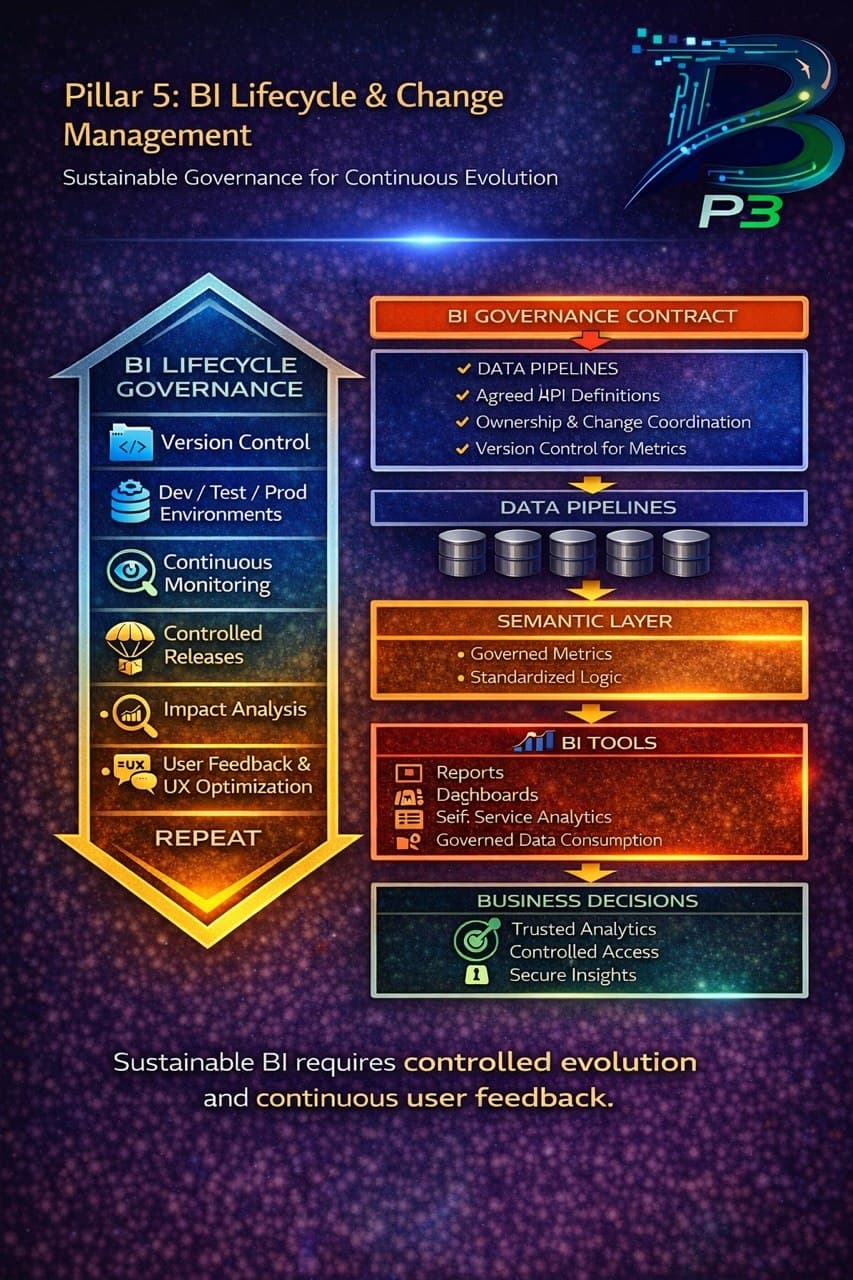
Pillar 5 — BI lifecycle governance
BI systems fail over time — not at launch. Without lifecycle governance, metrics drift, dashboards break, and trust declines gradually. By the time someone notices, damage is widespread.
Governed Self-Service
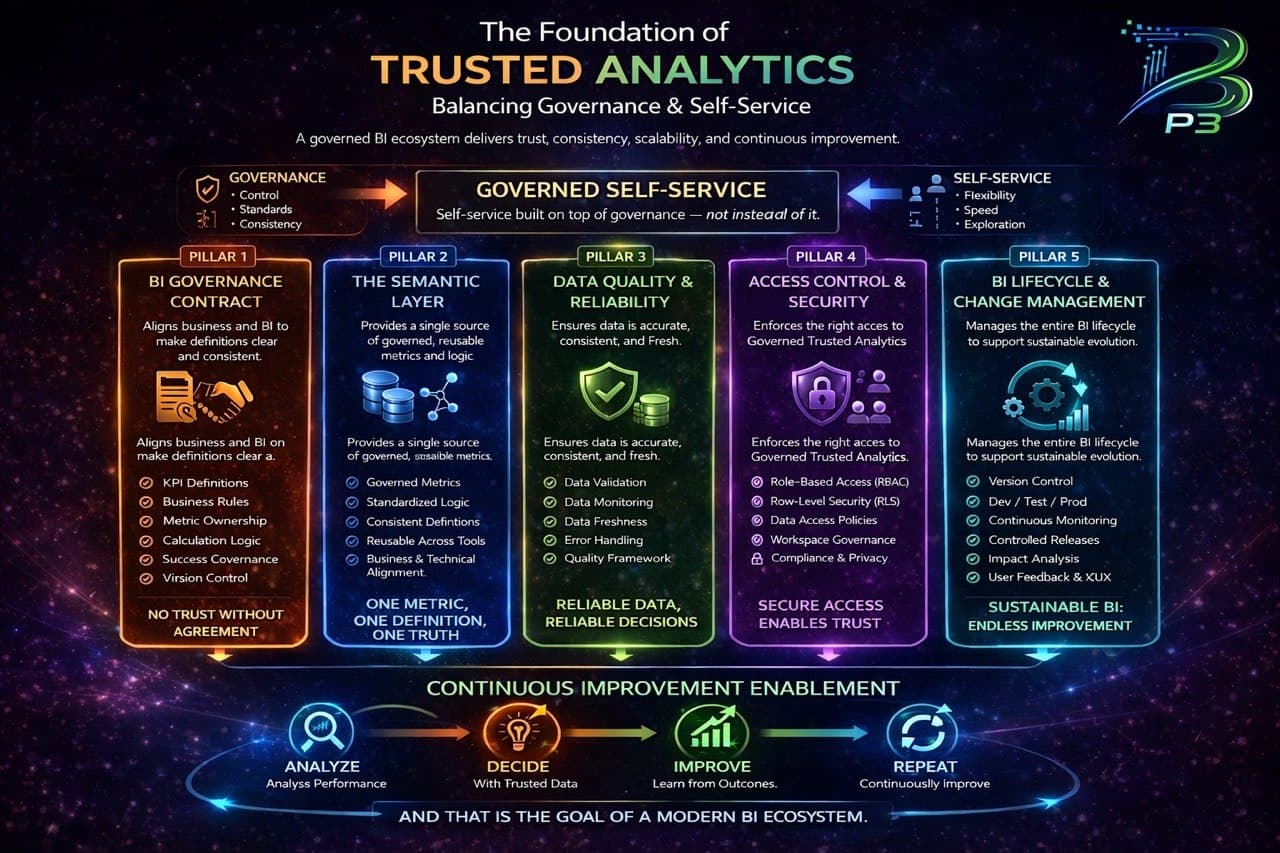
Balancing governance and self-service
The real challenge in any BI environment is the tension between control and autonomy. Most organizations choose extremes — either locking everything down or letting everything go. Neither works.
- Defined KPIs and owners
- Semantic layer enforcement
- Reliable pipelines
- Role-based security
- Business-led exploration
- Faster insight generation
- Decentralized reporting
- Empowered teams
Beyond BI: Continuous Improvement Enablement
A governed BI ecosystem is not just an IT asset — it is an operational one. When data can be trusted, it enables:
- Confident analysis without second-guessing numbers
- Better, faster decisions at every level
- Structured learning loops fed by reliable data
- Continuous improvement cycles with measurable outcomes
BI Governance Maturity Model
Where does your organization sit?
Most organizations operate at Level 1–2. The gap between Level 2 and Level 3 is often the hardest to cross — not technically, but organizationally.
Business Impact
A governed BI ecosystem enables tangible outcomes across the organization:
- Faster decision-making at every level
- Reduced inconsistencies and metric disputes
- Higher trust in data, leading to higher adoption
- Scalable analytics that grows with the organization
- Lower operational risk from broken or stale reports
Conclusion
BI is not a reporting function. It is a decision system.
And like any system, it must be governed, it must evolve, and it must be trusted. Organizations don't scale with more dashboards — they scale with better decisions.
Governance without self-service creates friction.
Self-service without governance creates chaos.
Together, they create trusted, scalable, continuously improving analytics.
Explore the framework